Emergent Pancreatic β-Cell Dynamics from Mechanistic Virtual Cell Modeling
A proprietary virtual cell system built on our original modeling framework and powered by Zoooo, reproducing ER-stress–driven apoptosis through intrinsic biochemical dynamics
Emergent Pancreatic β-Cell State Visualization
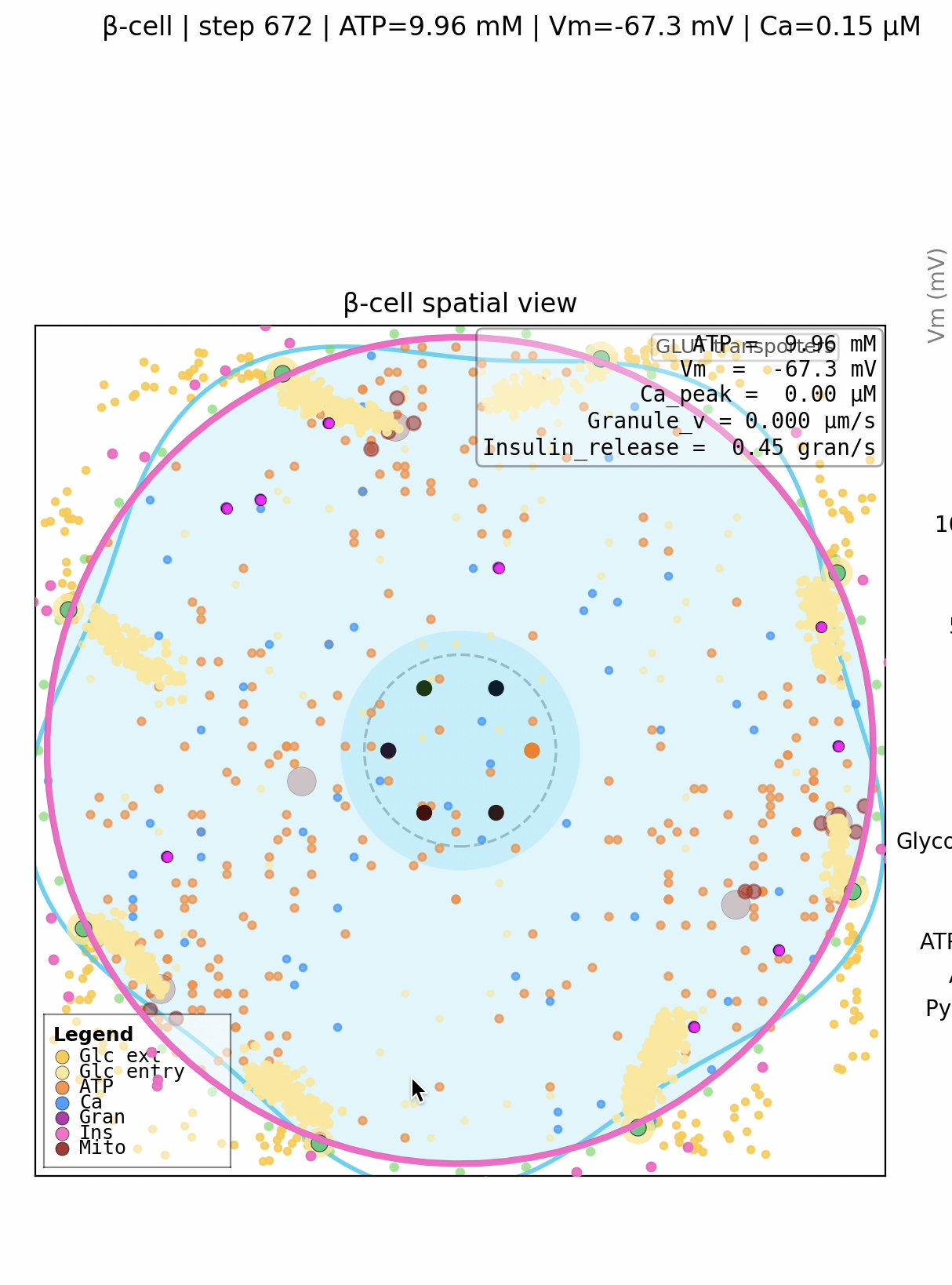
This figure shows a snapshot of the virtual pancreatic β-cell simulation at step 672, visualizing the spatial organization and interactions of metabolic, ionic, and signaling components. In this system, each simulation step corresponds to 1 second of real biological time, ensuring that the dynamics evolve on a physiologically consistent temporal scale.
Each particle represents a biological entity (ATP, Ca²⁺, insulin granules, mitochondria), interacting continuously within a unified dynamical system. No external rules or predefined triggers governing cell fate are imposed. As a result, the virtual cell evolves purely from intrinsic biochemical interactions and naturally transitions to apoptosis under sustained ER stress conditions.
Importantly, across multiple independent simulation runs, apoptosis consistently emerges at approximately 2320 steps (~40 minutes), demonstrating strong reproducibility and aligning closely with experimentally observed timescales of acute ER-stress–induced apoptosis. This indicates that the model captures underlying biological causality, rather than merely reproducing surface-level behavior.
Apoptosis is not programmed. It emerges.
Mechanism-first simulation.
- —Metabolic flux dynamics
- —Calcium signaling and electrophysiology
- —ER stress and unfolded protein response (UPR)
- —Gene regulatory feedback
- —Continuous lifecycle state transitions
- —All modules are dynamically coupled, forming a unified system in which cross-scale biological interactions drive system-level behavior.
- —Established virtual β-cell–based disease modeling systems
- —Accelerated compound screening through mechanism-level evaluation
- —Successfully developed and advanced multiple therapeutic candidates
- —Particularly in:
- —Type 2 Diabetes
- —Gout and metabolic disorders